Resources® Playground
A large-scale building system for movement, cooperation, and shared play
When what we build matters more than what I build.
When each child holds one kind of resource, something greater begins to take shape between them
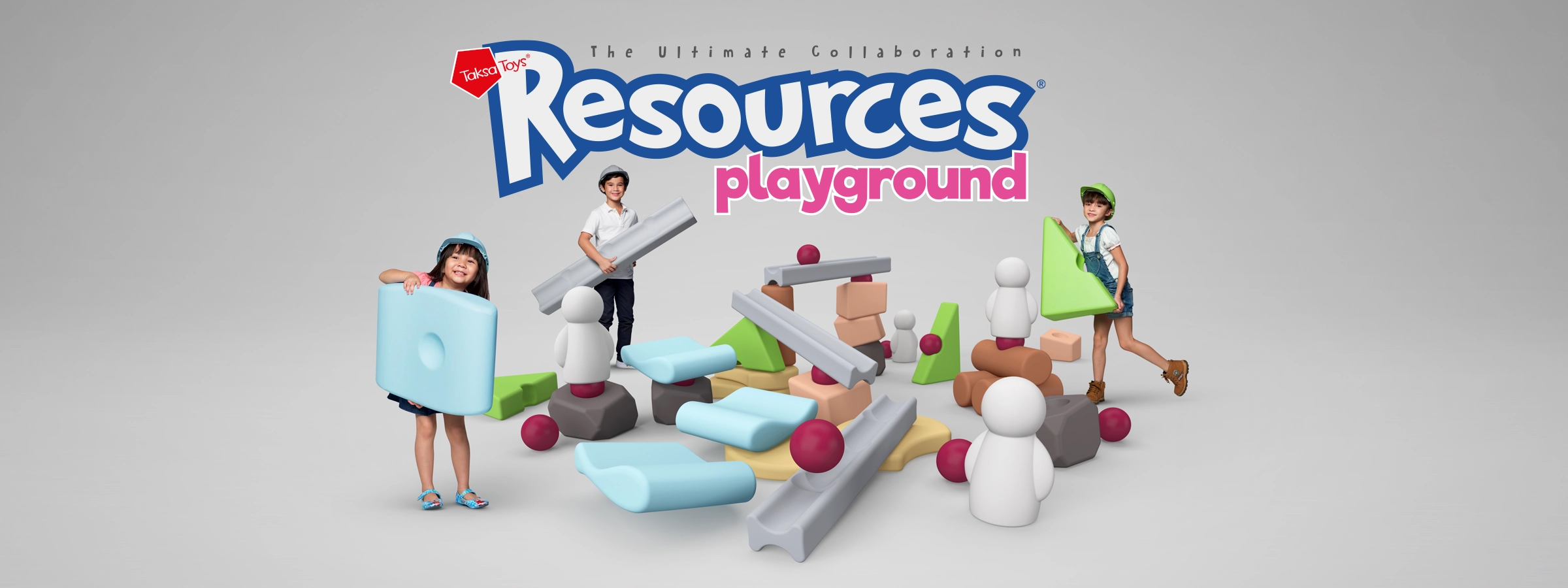
Resources® Playground brings the ideas behind Resources® beyond the tabletop and into a space children can enter with their whole bodies. Familiar forms become large pieces to lift, move, turn, and position as the construction grows around them.
At the heart of collaborative play is a simple rule: each child is assigned one kind of resource. No one has everything needed to create what they have in mind. A missing piece may be held by someone else, so children must talk, exchange, negotiate, and decide how their different resources will be used together.
As resources held across the group are brought together, something greater gradually takes shape between them. Its significance lies not only in its physical scale, but in the fact that it has been shaped by many hands, ideas, and decisions.
No one has everything
In group play, each child can be assigned a different resource. The role may be indicated by the color of a helmet or outfit, or simply agreed upon before play begins. One child may have Stone, another Water, while Wood, Sand, Steel, Brick, and Tree are held by other players.
Being responsible for one resource gives each child a role in deciding how it will be used. It does not mean keeping the pieces to themselves. Instead, it creates a reason to approach another player, propose an exchange, ask for help, or agree on where and when a piece should be used.
Sometimes their ideas will align. Sometimes they will not. A child may need to explain what they are trying to build, listen to another point of view, or revise the plan so that different needs can fit within the same construction.
Progress does not come from what one child holds, but from how everyone’s resources are brought together.
A small society with no winners or losers
Resources® Playground has no opposing sides and no goal of defeating another player. Everyone shares the same play space, works with a different resource, and takes part in deciding what those resources will become.
Children may agree, disagree, reconsider, or work toward a new arrangement. These moments are not interruptions to the play. They are part of the building process itself.
Each child is responsible for the resource assigned to them, while also seeing how their decisions affect what others are trying to do. In this way, the play space begins to function like a society in miniature, giving children opportunities to share, navigate different ideas, and find a way forward together.
Resources® Playground does not provide a fixed lesson in how people should live together. It creates situations that children can encounter, negotiate, and work through within the play itself.
What they build belongs to everyone
When the pieces, ideas, and decisions come from many players, the result cannot belong to one child alone.
Each child may take responsibility for a different part, but that part gains meaning through its relationship with everything around it. Success is not measured by who builds the most or finishes first. It comes from how separate contributions become part of one shared whole.
What emerges is both a collective creation and something the group continues to support throughout the play.
When pieces from everyone have to come together
Balance does not belong to one child. It is formed between them.
Resources® Playground uses no connectors, magnets, or locking mechanisms. Each construction depends on the relationship between shape, weight, angle, contact points, and placement.
At certain moments, pieces held by several players may need to be lifted, positioned, or adjusted at nearly the same time. When one point shifts, the weight and alignment of other parts may change with it. Actions begin to overlap, and timing begins to matter.
Children have to notice where to pause, what to adjust, and when to act together. The construction holds when the pieces and actions of the group begin to align.
Building with the whole body
In Resources®, children explore balance with their fingertips. In Resources® Playground, the same principles move through the whole body.
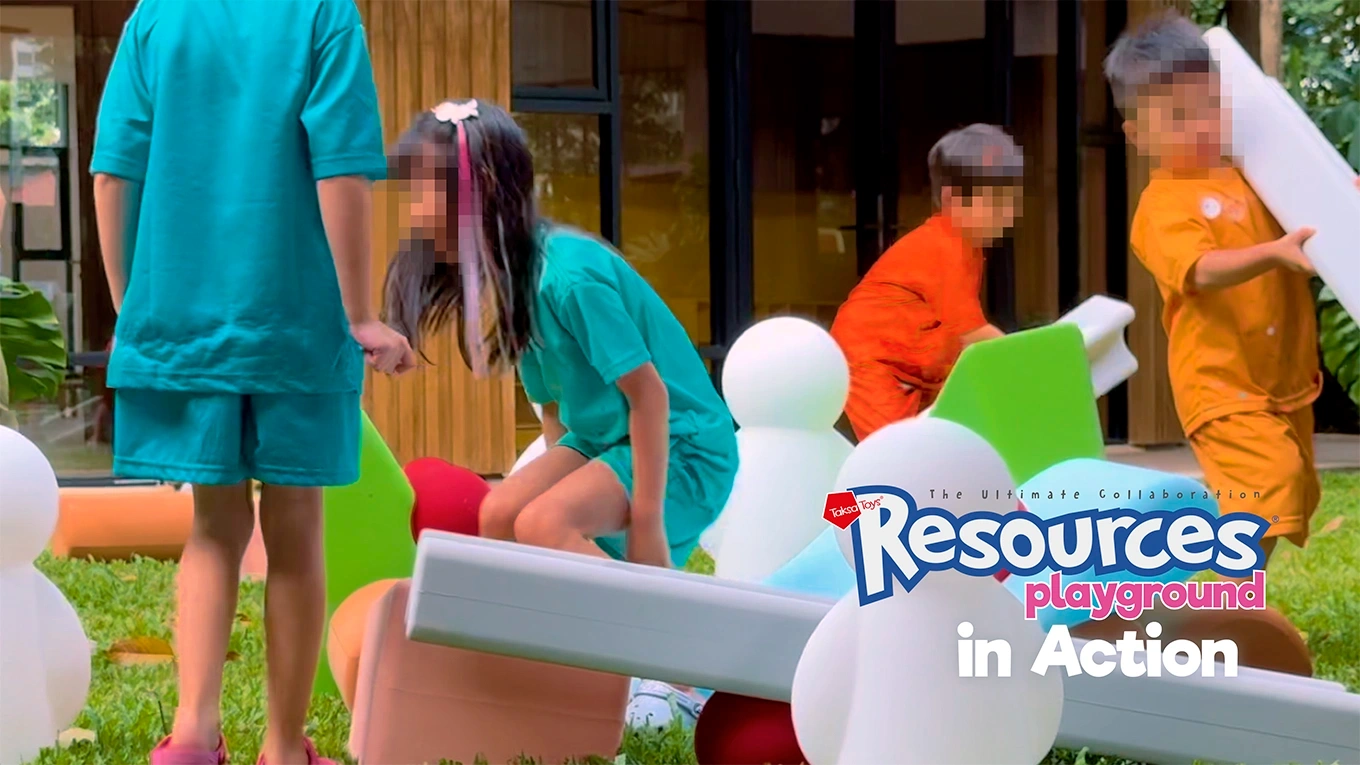
The size and weight of the pieces bring gross-motor movement, spatial judgment, and body control into the construction process. Children use physical effort to move, turn, and position each form while considering its weight, the surrounding space, and what has already been built.
Even a small adjustment can require both strength and precision. Movement is not separate from thinking. It is how children turn an idea into something real within the space around them.
Movement on a larger scale
At this larger scale, the Ball introduces movement across the entire construction.
It can travel across slopes, gaps, and changing levels created by the group. A small change in angle or distance may affect its direction, speed, or ability to continue along the route.
The Ball turns movement into something everyone in the space can see, anticipate, and respond to together.
Play can begin before the whole group arrives
Although Resources® Playground is designed around collaborative play, children do not need to wait for a full group before beginning.
A single child can build, explore balance, create pathways, and experiment with movement. As more players join, roles, resource rules, and exchanges can be introduced, bringing negotiation and shared decision-making into the experience.
The same system can support individual exploration, small-group play, and full collaborative play with a larger group.
Read more about play and child development: How sharing resources, listening, moving together, and making decisions as a group create opportunities to cooperate and work through differences. Why Play Matters in Child Development →
Designed for shared play spaces
Resources® Playground is designed for schools, learning environments, and other spaces where children can build and move together.
It is intended for approximately 7 to 9 players. The recommended active play area is about 400 square feet, or 37 square meters, with approximately 30 additional square feet, or 2.8 square meters, for pieces not currently in use.
Adequate space allows children to see the construction as a whole, move pieces between locations, and reach different areas without the play environment becoming overcrowded.
Resources® Playground can be used indoors or outdoors. When not in use, the pieces should be stored in a dry, covered area.
Weight and surface grip designed for large-scale play
Each piece is made from food-contact-grade polyolefin plastomer. The material has slight flexibility while holding its form during lifting, movement, placement, and repeated adjustment.
Its surface provides enough grip to help pieces rest against one another, including across sloped faces, without sliding out of position too easily. This gives children time to refine angles, contact points, and placement as the construction becomes more complex.
Each piece is a fully enclosed form with a hollow interior. This keeps the weight manageable for children without removing physical effort from the play. The pieces still require deliberate lifting, carrying, and positioning.
Weight and surface grip work together. The pieces require controlled movement, while the material helps children maintain control when building across angled surfaces.
The pieces can be cleaned with a hose and scrub brush. A pressure washer may be used for heavier dirt where appropriate.
Resources® Playground begins with resources held by individual children and gradually becomes something everyone builds, shares, and cares for together.
Learn to build. Learn to share. Learn to live together.
Designed for children ages 4 and up.
Different systems, one shared belief
Each TaksaToys system expresses the same belief: children can learn through direct experience, with each system offering a different way to engage.
- Resources® invites children to explore balance, placement, and how each choice changes what happens next.
- Arch-Kid-Tech® makes structural principles, alignment, and force transfer visible through building.
- LOCOMO® invites children to observe, interpret, and create stories with elements found in nature.
- Resources® Playground brings movement, coordination, and collaboration into play.
Explore TaksaToys’ approach to Play-Based Learning.
Resources® Playground: Building together through movement and cooperation
Move together. Share resources. See how balance takes shape between players.