
Play-Based Learning
How understanding takes shape through action
Before we design for children, we need to understand how they grow.
Learning takes shape through action
Children do not learn through explanation alone. They also learn by moving, touching, testing, observing, communicating, and responding to what happens around them.
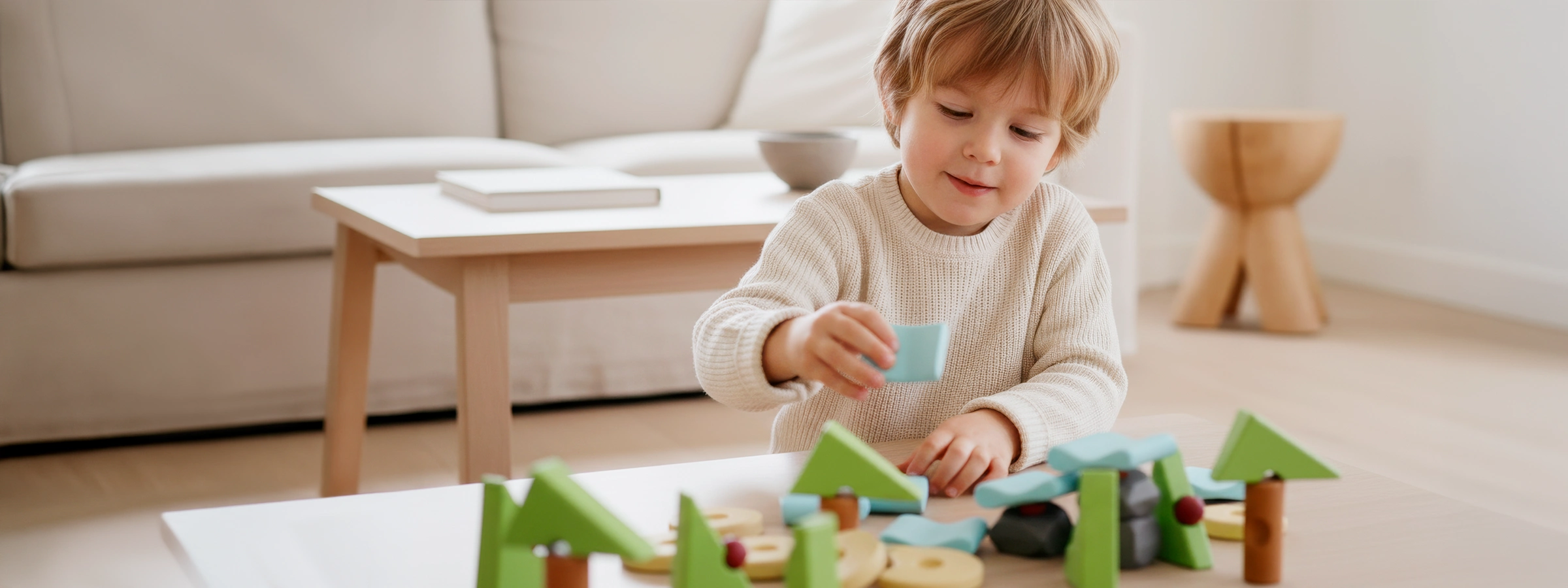
A child places a piece, watches it shift, and adjusts it. Another child joins with a different idea. A structure falls, a plan changes, and the next attempt begins with more information than the first.
These moments may look simple, but they bring several processes together. Children use perception and movement, hold an intention in mind, respond to change, and make decisions based on what they can see and feel.
Play-based learning begins here. Understanding develops through active participation rather than being delivered as a finished answer.
What makes play a learning environment
Play does not become meaningful simply because a child is using a toy. The quality of the experience depends on what the child is able to do, notice, decide, and change.
Children take an active role
In play-based learning, children are not only following instructions or reproducing a predetermined result. They handle materials, test possibilities, and make choices that affect what happens next.
The experience gives them something real to act upon.
Choices have visible consequences
When a piece moves, a structure becomes unstable, or a ball changes direction, children can see the relationship between an action and its result.
The outcome becomes information. Children can pause, compare, adjust, and decide what to try next.
There is room to try again
Learning does not occur only when something works.
A structure that falls, a piece that does not fit, or an idea that changes direction can create another opportunity to observe and respond. Trying again is not merely repeating the same action. Each attempt can begin from something newly noticed.
Other people become part of the experience
Play can also involve listening, explaining, waiting, exchanging materials, and making decisions with others.
When children build together, their ideas do not always align immediately. The need to communicate and adjust becomes part of the play itself, rather than something added as a separate lesson.
Designed without taking over
Play-based learning can include intention without removing the child’s agency.
An adult, educator, or designed system may introduce materials, questions, relationships, or possibilities. But the child still needs meaningful room to explore, interpret, decide, and respond.
At TaksaToys, we do not begin by deciding what every child must create or exactly how the experience should unfold. We begin by designing conditions in which important relationships can become visible.
A curve changes how a piece rests. Alignment affects whether a structure stands. A natural object changes the character it becomes part of. A missing resource creates a reason to approach another player.
The system provides a starting point, but the child remains an active participant in what follows.
Learning becomes visible through change
One of the strengths of hands-on play is that thinking can often be seen through action.
A child turns a piece before placing it. Stops to check an alignment. Chooses one material over another. Moves closer to look again. Changes a plan after hearing someone else’s idea.
These actions do not reveal everything a child is thinking, but they allow adults to observe how an understanding may be developing.
The value is not limited to the finished structure or character. It is also present in the moments of choosing, comparing, hesitating, adjusting, and beginning again.
What research helps us understand
Research in pediatrics, psychology, neuroscience, and education describes play as an important context for childhood learning and development.
Active and meaningful play can bring movement, communication, memory, self-control, flexible thinking, problem solving, and social participation into use within the same experience. These areas do not develop in isolation, and no single activity produces the same result for every child. Research helps us understand why opportunities to act, observe, communicate, and adjust can matter. [1] [2] [3]
For a closer look at the evidence behind play and child development:
Why Play Matters in Child Development →
From principle to practice
A principle becomes meaningful when it can be observed in what children actually do.
See how development may become visible through real play experiences and change as children gain experience.
How It Grows →
Different systems, one shared belief
Each TaksaToys system offers a different way for children to learn through direct experience.
Resources® creates an open-ended construction space in which children place, stack, turn, and adjust pieces while observing how balance changes.
There are no connectors or fixed outcomes. Each placement affects what becomes possible next.
Explore Resources® →
Arch-Kid-Tech® introduces structural principles through step-by-step construction, alignment, load, and precise placement.
Children begin by following a sequence, then gradually develop a clearer understanding of why each part must be positioned as it is.
Explore Arch-Kid-Tech® →
LOCOMO® begins with searching and noticing.
Children collect natural materials, compare their shapes and textures, and decide how each discovery might become part of a character or story.
Explore LOCOMO® →
Resources® Playground brings construction into a space children can enter with their whole bodies.
Movement, resource exchange, communication, and shared decisions become part of creating something that no one child could build alone.
Explore Resources® Playground →
Share what you observe
Educators and families often notice details that theory alone cannot capture.
A child may discover an unexpected way to use a piece, return to the same challenge with a new approach, or create a form of collaboration that the adults around them had not anticipated.
We welcome observations from classrooms, homes, and other places where children play. By sharing what you notice, you can contribute to a broader understanding of how children explore, adapt, and grow through play.
Play-based learning at TaksaToys
We design systems that give children something real to act upon, observe, discuss, and reconsider.
The materials and rules may differ, but the belief remains the same:
Children learn not only from what they are told, but from what they are able to do, notice, and understand for themselves.