How Spatial Skills Shape Thinking and Learning in Children
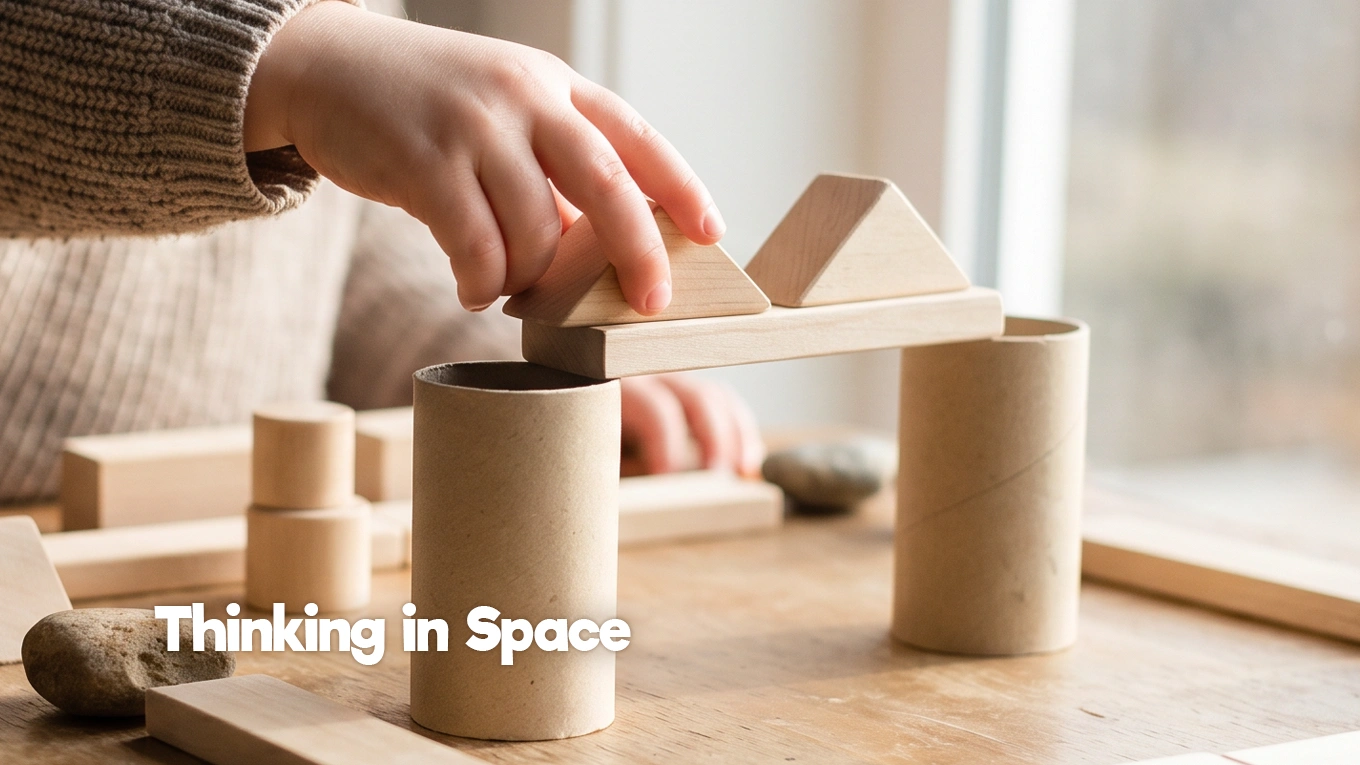
Spatial skills in children begin in small, ordinary moments. A child turns a puzzle piece until it fits, places one block on top of another, reaches behind a cushion, or notices that a smaller cup can sit inside a larger one. These actions may look simple, but they help children understand shape, position, movement, and relationship in the physical world.
Seeing the World in Three Dimensions
Watch a toddler work out which shape fits through which opening, and you are seeing a quiet form of reasoning. The child is not only holding an object. They are turning it, comparing it, and beginning to imagine how it might move through space before it succeeds or does not.
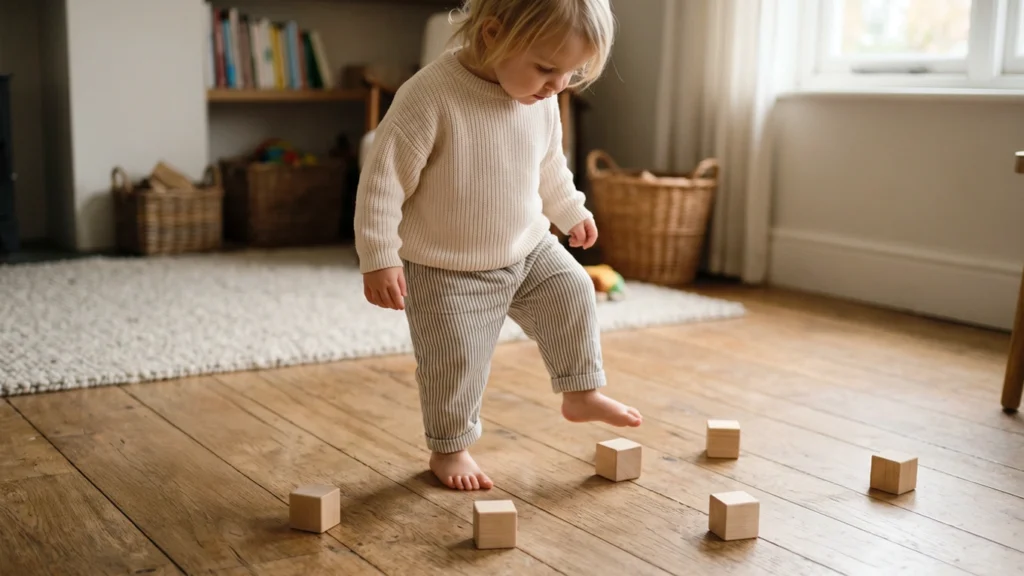
This ability is often called spatial visualization. It includes mentally rotating objects, noticing how parts relate to one another, and imagining something that is not directly in front of us. These skills continue to appear as children grow. They help with building, drawing, reading maps, packing a bag, understanding fractions, and later learning in areas such as geometry, engineering, architecture, medicine, and physics.
The useful thing to remember is that spatial skills are not fixed. They can grow through repeated, hands-on experiences where children observe, adjust, and try again.
The Mechanisms of Spatial Intelligence
Mental Rotation: Turning Objects in the Mind
Mental rotation is the ability to picture an object and imagine how it would look if turned, flipped, or moved. Adults use it when judging whether furniture will fit through a doorway. Children practice it when they rotate a puzzle piece or turn a block until it finally aligns.
Research has shown that young children can begin developing this ability through hands-on puzzle play. In one longitudinal study, preschoolers who played with puzzles more often between ages two and four later performed better on spatial transformation tasks. The finding is not a reason to rush children. It simply suggests that repeated, concrete play can give the mind something useful to work with.
Spatial Mapping: Understanding Relationships
Spatial mapping is the ability to understand where things are in relation to one another. It is the thinking behind words such as “next to,” “behind,” “above,” “between,” and “through.”
Children build this understanding by moving through real spaces. A toy goes under the chair. A block sits beside another block. A road passes under a bridge. Over time, these repeated observations help children form a clearer sense of position, distance, and direction.
Neuroscience often points to the parietal cortex as an important area for processing spatial information. For parents and teachers, the practical meaning is simple: the brain strengthens what it has chances to practice. Spatial thinking grows through movement, placement, comparison, and repeated adjustment.
The Bridge to Mathematical Thinking
Spatial skills in children also connect closely with early mathematical understanding. When a child imagines half of a pizza, divides blocks into equal groups, or sees how two shapes can make a larger shape, they are using space to make sense of number and quantity.
Research reviews have found that spatial ability training can improve mathematical performance, especially in geometry, word problems, and numerical relationships. This does not mean spatial play is a shortcut to academic success. It means that spatial thinking gives children another way to approach abstract ideas.
Numbers can feel invisible. Shapes, blocks, cups, and drawings make some of those ideas visible. A child can move them, test them, and see what changes.
Paths to Development: Everyday Ways to Support Spatial Thinking
Bring Spatial Language into Daily Moments
One of the simplest ways to support spatial development is through ordinary conversation. Instead of turning spatial learning into a formal lesson, name what is already happening.
“Let’s put your cup beside your plate.”
“Can you find the toy behind the pillow?”
“Look how the road goes under the bridge.”
These words help children connect what they see with language. Over time, the child begins to notice position and relationship more clearly.
Encourage Building Without Rushing to Fix
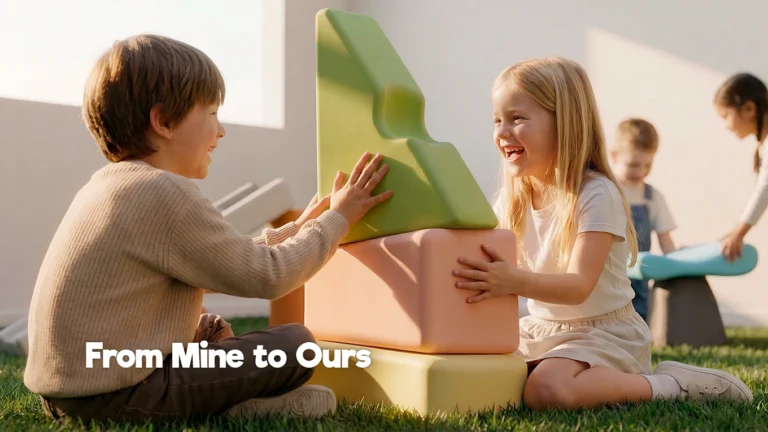
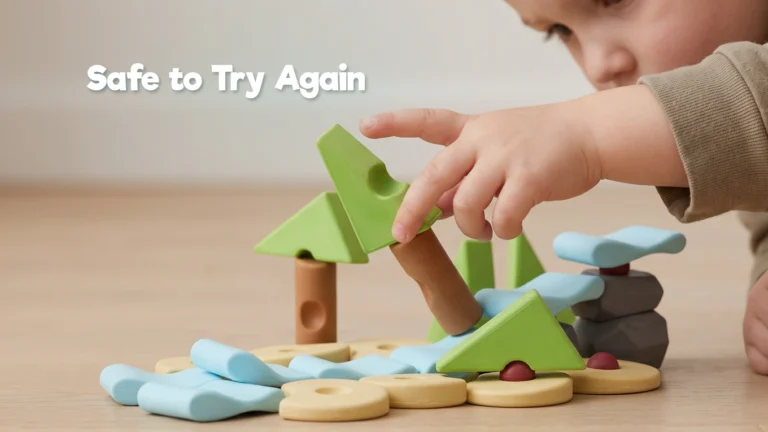
When children build, they practice balance, proportion, planning, and adjustment. A tower leans. A base is too narrow. A bridge does not hold. These are not failures to remove too quickly. They are visible information.
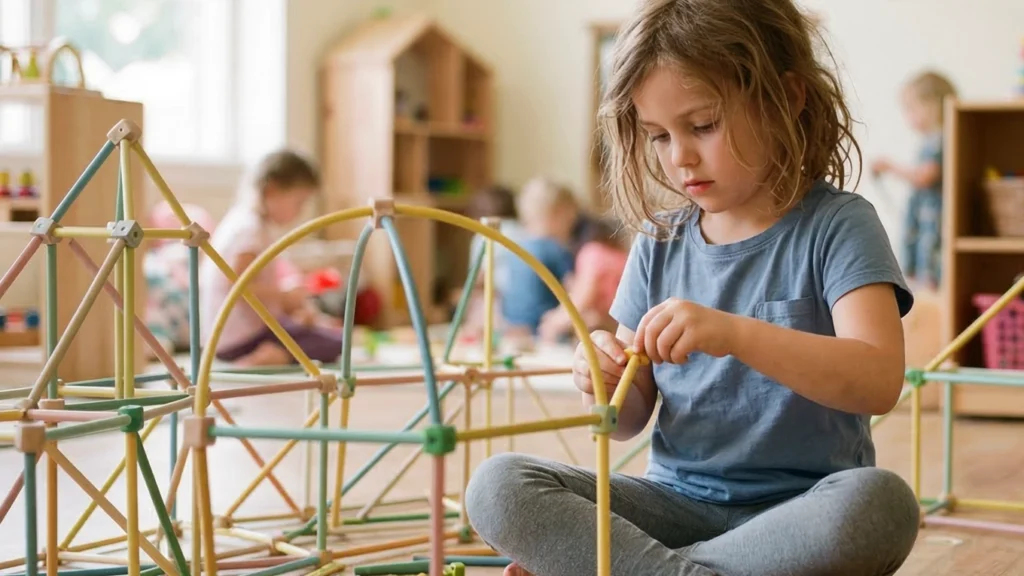
Instead of correcting immediately, try asking, “What might happen if the base is wider?” or “Which piece feels more stable here?” Questions like these keep the child inside the thinking process.
Use Puzzles and Shape Sorting Gradually
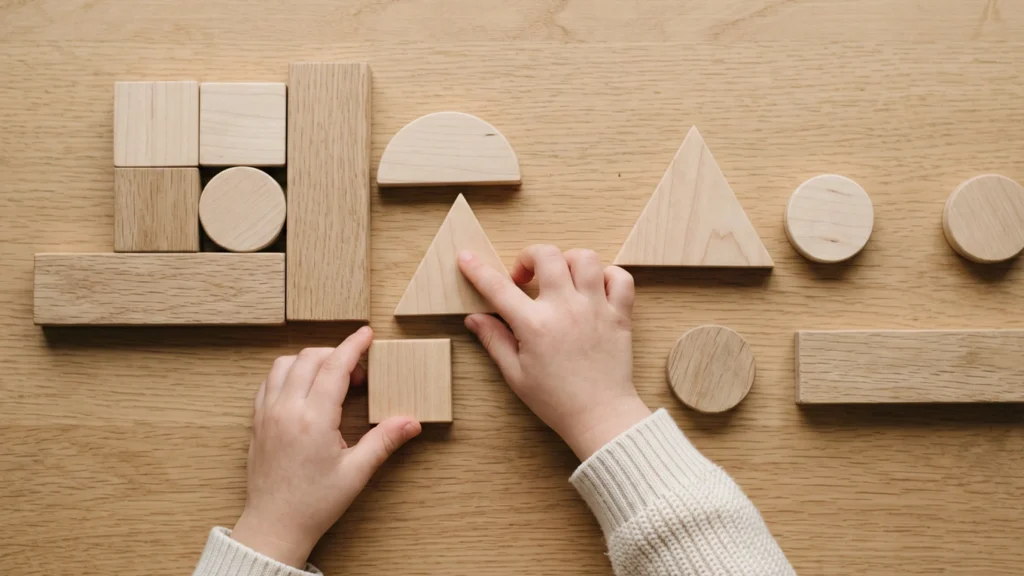
Puzzles and shape sorters give children a clear spatial problem. A piece either fits or it does not yet fit. The important part is not speed or perfection, but the cycle of trying, turning, noticing, and changing approach.
Start with simpler forms, then add complexity as the child is ready. The goal is not to make the task difficult. It is to keep the child observing with enough challenge to stay curious.
Leave Room for Open Exploration
Structured activities can be useful, but open-ended play matters too. When children stack cups, nest bowls, arrange shoes by size, or build with cardboard boxes, they are often discovering spatial relationships without being told what to find.
This kind of exploration gives children time to notice. A smaller object fits inside a larger one. A long piece changes the balance. A flat surface holds differently from a rounded one. Understanding begins through contact.
Materials That Invite Spatial Thinking
When choosing toys or materials, it may help to look less at labels and more at what the child can actually do with them.
Open-ended building blocks allow children to see how parts create a larger whole. Transparent building tiles show layering, overlap, color, and shape. Nesting and stacking objects make size and fit visible. Structural building sets with rods and connectors invite children to think about stability, direction, and three-dimensional form. Puzzles offer a clear space for rotation, comparison, and persistence.
Everyday objects can work just as well. Cardboard boxes, measuring cups, folded cloth, stones, leaves, or shoes arranged by size can all become material for spatial thinking when children are allowed to handle, compare, and reorganize them.
A Few Final Thoughts
Spatial skills develop over time, and not every child enters through the same door. Some children are drawn to building and puzzles. Others may notice space through movement, drawing, pretend play, nature, or helping in the kitchen. These differences are normal.
What matters is not forcing a child toward one kind of activity, but offering repeated chances to observe relationships in the world around them. A shape turns. A structure shifts. A child pauses, adjusts, and tries again. In those moments, thinking becomes visible.
Parents and teachers do not need to turn every moment into a lesson. Often, the most useful support is slower and simpler: name what is happening, give space for trial and error, and let the child meet the physical world with attention.
*This article is for informational purposes only and does not constitute medical or therapeutic advice. If you have concerns about your child’s development, please consult a pediatrician or occupational therapist.*