How Children Learn from Mistakes
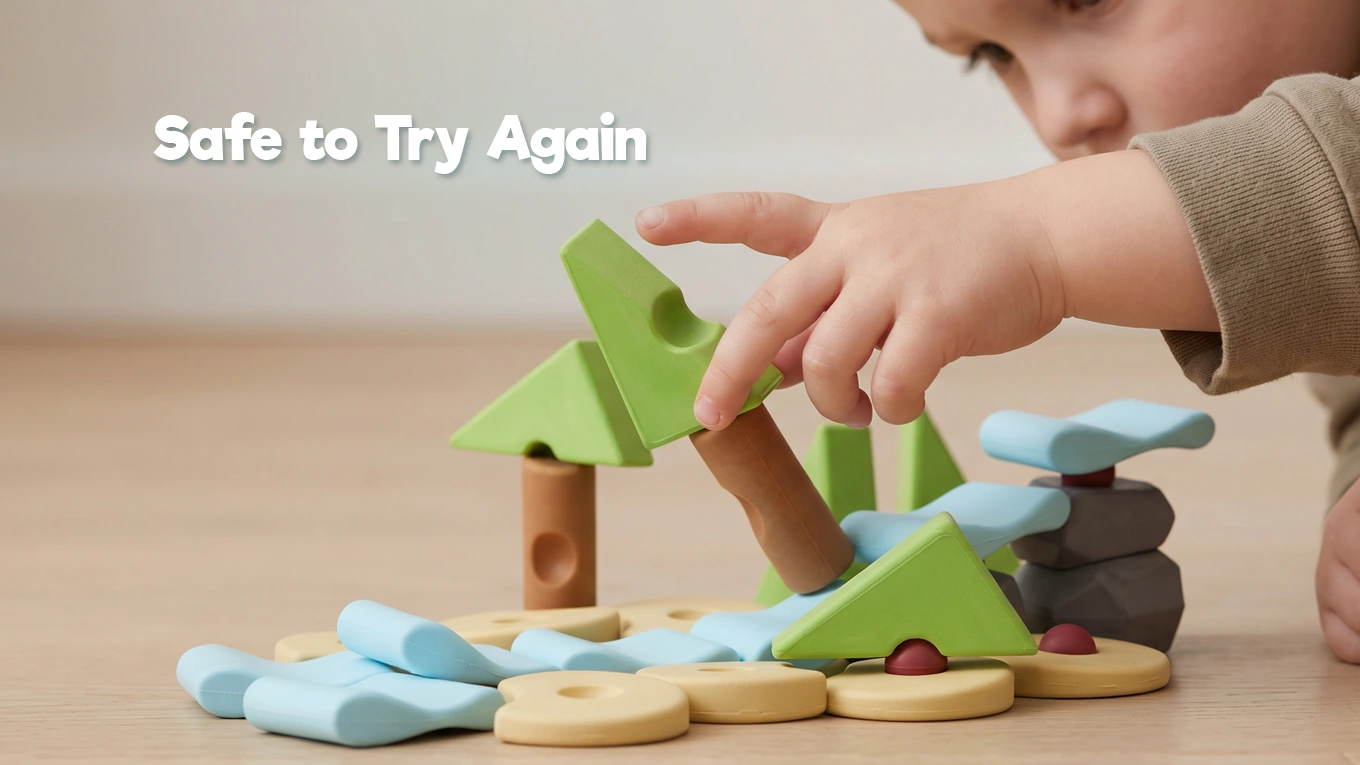
Children learn from mistakes in small, visible moments: a tower leans too far, a puzzle piece refuses to fit, or a drawing turns out differently from what they imagined. These moments can feel frustrating, but they also give children a chance to pause, notice what changed, and try another way.
There is a moment many parents and teachers recognize. A child is working with focus, perhaps stacking blocks, solving a puzzle, building with loose parts, or drawing a picture. Then something goes wrong. The tower falls. The piece does not fit. The line slips across the page. The child’s face changes, and the frustration is immediate.
It is natural to want to step in and fix the problem quickly. Adults often do this out of care. But not every difficult moment needs to be removed. Sometimes, the struggle is where the learning begins.
When children learn from mistakes, they are not simply repeating the same action again and again. They are gathering information. They notice what did not hold, what did not match, what moved too quickly, or what needed more care. Over time, these small adjustments help children build patience, resilience, and a more flexible way of thinking.
Why Mistakes Can Lead to Deeper Learning
Getting something right on the first try can feel satisfying. But it does not always give a child much to examine. When everything works immediately, there may be little reason to pause, compare, or adjust.
A mistake changes that. It interrupts the action and makes something visible. The child sees that the base was too narrow, the piece was turned the wrong way, or the material responded differently than expected. The mistake becomes a form of feedback.
This connects with what many educators describe as a growth mindset, the belief that ability can develop through effort, strategy, and practice. When children begin to understand that a mistake does not mean “I cannot do this,” but rather “something needs to change,” they are more likely to stay with a challenge.
Researcher Manu Kapur has also written about “productive failure,” where learners first struggle with a problem before being shown the solution. The value is not in failure itself, but in giving learners enough space to explore the problem, notice its structure, and become more ready to understand the solution when it appears.
The useful kind of struggle is not overwhelming. It stays within reach. A child may not know the answer yet, but they can still try something. They can turn the piece, shift the block, ask a question, or begin again.
Seeing Mistakes as Information
Young children are natural experimenters. They stack, pour, press, sort, knock down, rebuild, and repeat. From an adult view, these actions may look simple or messy. From the child’s view, they are ways of discovering how the world responds.
A falling tower gives information about balance. A puzzle piece that does not fit gives information about shape and direction. Clay that collapses gives information about pressure and form. A pattern that breaks gives information about sequence. These are not abstract lessons. They are visible consequences that the child can observe directly.
This is why the way adults respond matters. If every mistake is treated as something to avoid, children may begin to choose only what feels safe or familiar. But when mistakes are treated as part of the process, children can approach difficulty with more steadiness.
This does not mean every mistake needs a long explanation. Often, the most useful response is simple and calm: “That part fell. What do you notice?” or “It did not fit that way. Do you want to turn it?” These small prompts keep attention on the task without turning the moment into a lecture.
The Adult’s Role: Support Without Taking Over
Supporting a child through mistakes requires balance. Too much help can take away the child’s chance to think. Too little help can leave the child overwhelmed and unable to continue.
The adult’s role is not always to solve. Sometimes it is to stay close, observe carefully, and offer just enough support for the child to keep going. This might mean holding a piece steady while the child places another one. It might mean asking a question instead of giving an answer. It might mean waiting a few seconds longer before stepping in.
Developmental psychologist Lev Vygotsky described the “zone of proximal development,” the space between what a child can do alone and what they can do with support. In everyday life, this space appears often. A child can almost complete the puzzle, almost balance the structure, almost tie the knot, almost explain what happened. The adult’s support helps the child remain inside the challenge without taking the challenge away.
Praise can also shape how children understand mistakes. Comments that focus on effort, strategy, and attention often help children notice what they did, not only whether they succeeded. “You tried turning it three different ways” gives the child a clearer picture of their own process than “Good job.” “You made the base wider after it fell” helps the child see the connection between action and result.
Practical Ways to Support Learning from Mistakes
One helpful habit is to pause before helping. When a child struggles, the first few seconds can be important. In that space, they may test another idea, look more closely, or decide to ask for help. A short pause tells the child that the situation is not an emergency.
Another helpful response is to describe what is happening. Instead of saying “No, that is wrong,” an adult might say, “That side is higher than the other side,” or “This piece has a curved edge.” Description keeps the child’s attention on what can be observed. It gives information without taking control.
It also helps when adults make their own mistakes visible in ordinary ways. “I put too much water in. I’ll try again.” “I forgot that step. Let me go back.” These small comments show that mistakes are not unusual or shameful. They are part of how people adjust.
The language around effort matters too. A sentence like “You stayed with it even when it was difficult” can help a child recognize persistence. “You changed your plan” can help them notice flexibility. None of this needs to be dramatic. The goal is to create an atmosphere where trying again feels possible.
Play Materials That Leave Room for Trying Again
Some materials make it easier for children to learn from mistakes because they do not close down after one wrong move. They allow children to revise, rebuild, reshape, or return to the beginning without feeling that the whole activity has failed.
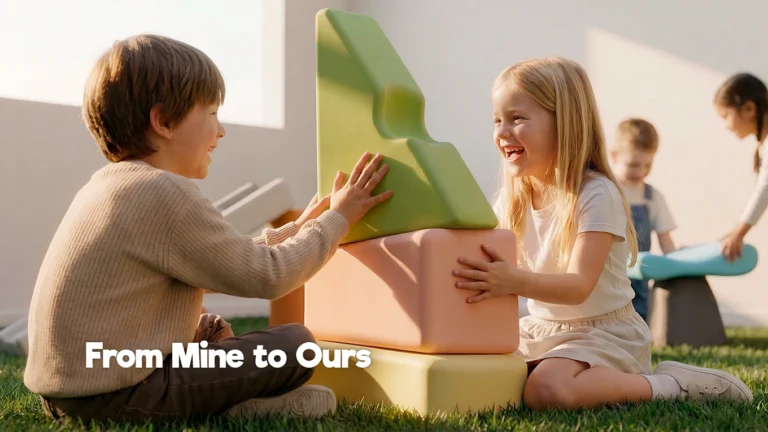
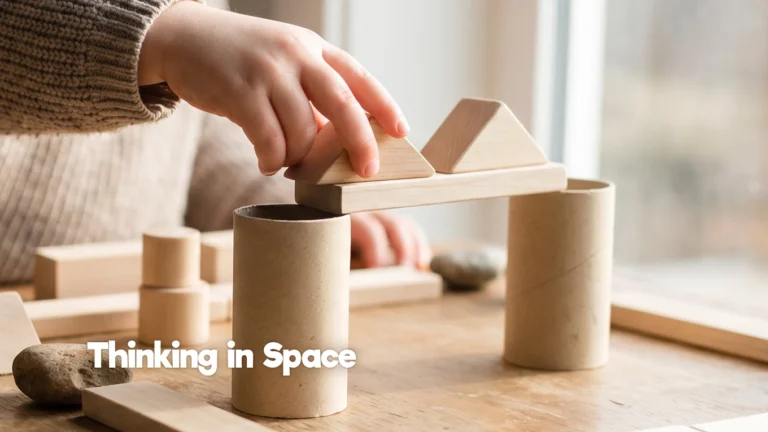
Open-ended building materials are useful in this way. Blocks, magnetic tiles, loose parts, and interlocking pieces do not need one correct answer. A child can build upward, widen the base, change the shape, or begin again. If the structure falls, the pieces remain available. The child can look at what happened and try a different arrangement.
Malleable materials offer another kind of freedom. Clay, playdough, and sand can be pressed, flattened, rolled, broken apart, and reshaped. A form that does not work can become something else. The material does not punish the child for changing direction.
Puzzles and pattern activities can also support this process when the level of challenge is appropriate. A piece that does not fit gives clear feedback. A sequence that breaks invites the child to compare what came before and what should come next.
The common quality is flexibility. Materials that allow revision help children experience mistakes as part of the work, not the end of it.
A Gentle Reminder for Parents and Teachers
Watching a child struggle can be uncomfortable. The impulse to make things easier often comes from care. But ease is not always what children need most. Sometimes they need time, space, and a steady adult presence beside them.
A child does not need every tower to stand. They do not need every piece to fit on the first try. They do not need every drawing to match the image in their mind. They need to know that a mistake is not the end of the process.
When children learn from mistakes, they learn more than how to fix one task. They learn that difficulty can be met, that adjustment is possible, and that trying again is safe.rn that difficulty can be met, that adjustment is possible, and that trying again is safe.
*This article is for informational purposes only and does not constitute medical or therapeutic advice. If you have concerns about your child’s development, please consult a pediatrician or occupational therapist.*